





|
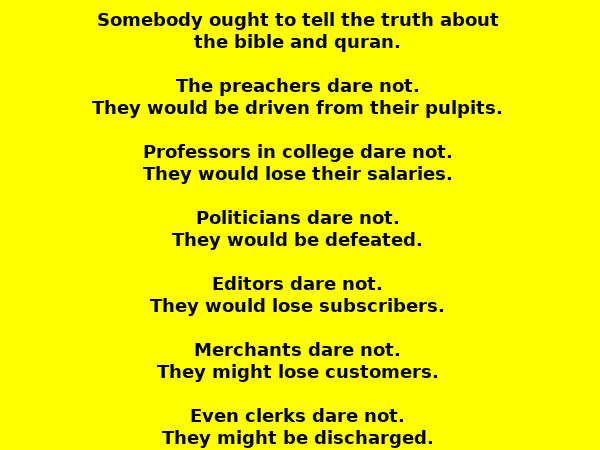
If you need a book to tell you how to be a good person,
you're not a good person. You're a bad person on a leash.
Genesis 1-1 thru Revelations 22:21 Religious zealots tell us that the Bible is proof of God. This is just plain false. The bible is merely an assertion that God exists, but provides no proof. If it can be said that the Bible is the proof of God, then it can also be said that Charles Darwin's book On The Origin Of Species, is proof of evolution.
Keep in mind that those who wrote the Bible had no idea where the sun went at night.
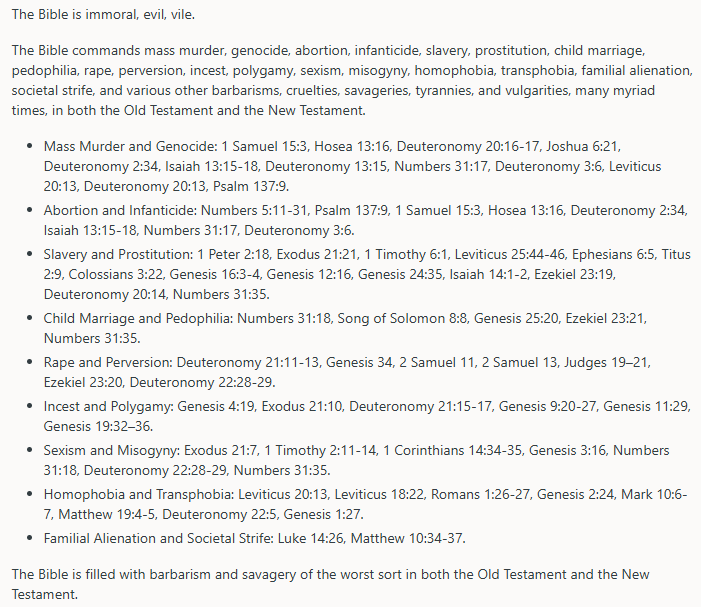
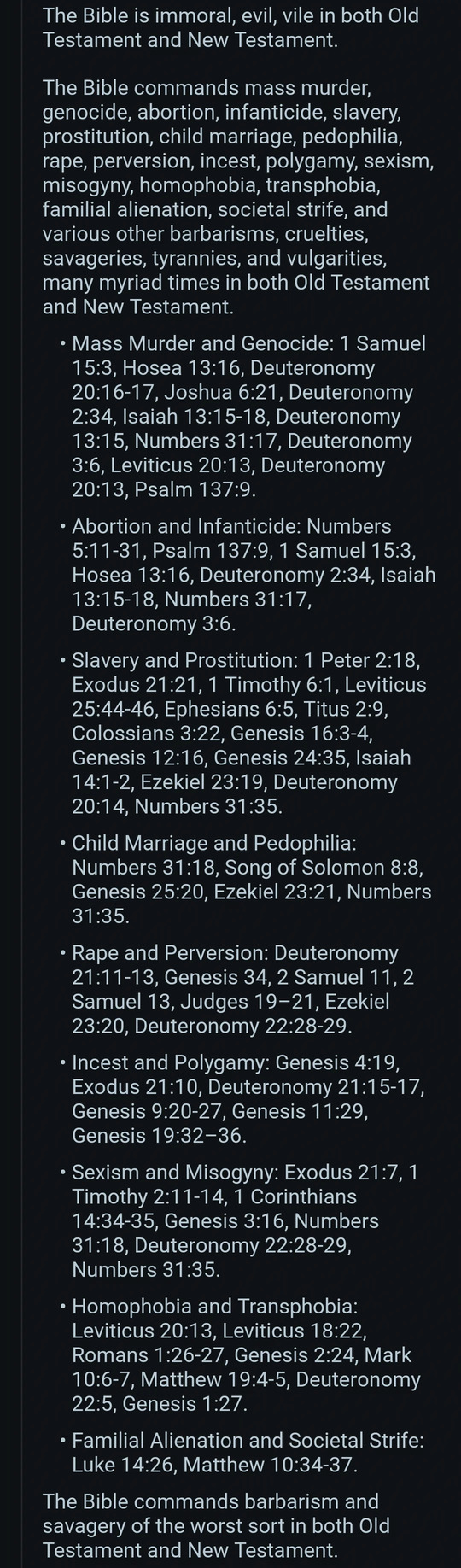
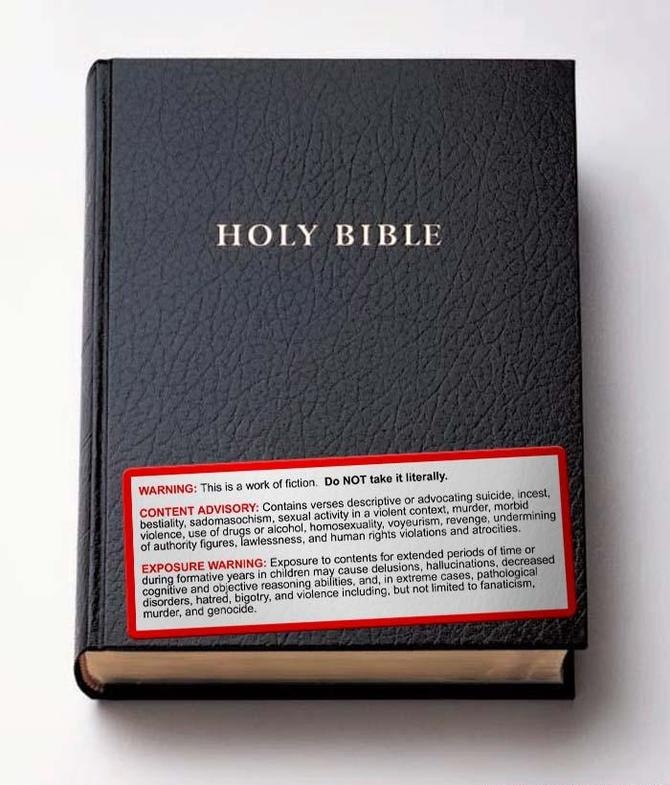
The Bible is an ancient novel chock-full of nudity, sex, murder, rape, genocide, patricide, fratricide, homicide, bestiality, seduction, drinking, cruelty, homosexuality, socialism, magic, witchcraft, wizardry, child and animal sacrifice, prostitution, swearing, lying, cheating, stealing, sexism, misogyny, adultery, polygamy, concubinage, superstition, idolatry, gambling, beatings, maimings, stabbings, testicle-crushing, and really bad morals. As if it didn't already contain enough bad* stuff to get it banned a thousand times over, the wretched book promotes slavery, telling you exactly who you can keep as slaves, and just how severely you can beat them. How cool is that?
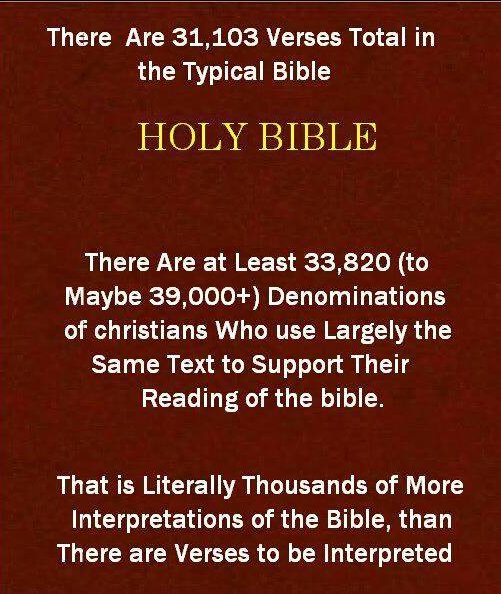
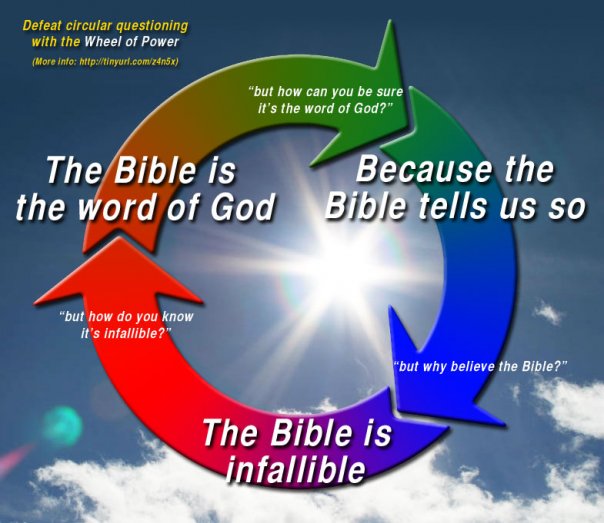
There are a multitude of different bibles and all are considered the inerrant word of God. If it often read to children on Sunday. The Pentateuch is the collection of the first five books of the Bible, from Genesis to Deuteronomy. This section covers the time between the creation of the universe and Israel's entrance into the Promised Land.
If it doesn't say what one wants to hear, therefore it's
Mix and match any or all of the above to taste.
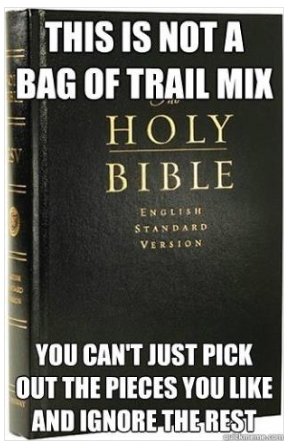
When a christian says they only follow the NT, they are not just throwing out Noah & the ark, they are also throwing out Adam & Eve, the Garden of Eden, Original Sin, Sodom & Gomorrah, Moses & the Exodus, the ten commandments and all the "prophecies" of a messiah. They are throwing out the entire reason god needed to send Jesus to die for the sins of mankind. Without the OT, the entire purpose of the NT doesn't exist. No, that just isn't how any of this works. If the bible is word & commands of a god, then it is ALL the word & commands of a god, and no mere human should have the audacity to throw ANY of it out. Take it all, or NONE of it matters.
We must keep children from learning Bible stories. Teaching children Bible is Child Abuse. The Bible is full of Rape, Misogyny, Genocide, Slavery, Torture, Humiliation and other things that are very traumatizing for children to learn about. It is even worse for them to internalize these messages of self-hatred, shame over sexuality however expressed, hatred and domination of women... This is child abuse to expose children to this material. The Bible should be considered "adults only" and any church with a Sunday School needs to be sued for child endangerment and spiritual rape.
The Bible consistently teaches an authoritarian model of the universe that you cannot question, where the group identity and conformance to that belief system is more important than attachment to reality and the ultimate goal is the destruction of this world and the overwhelming majority of the people on it, with a chosen few selected by the authoritarian to be rewarded with favor and the out group is cursed with eternal suffering.
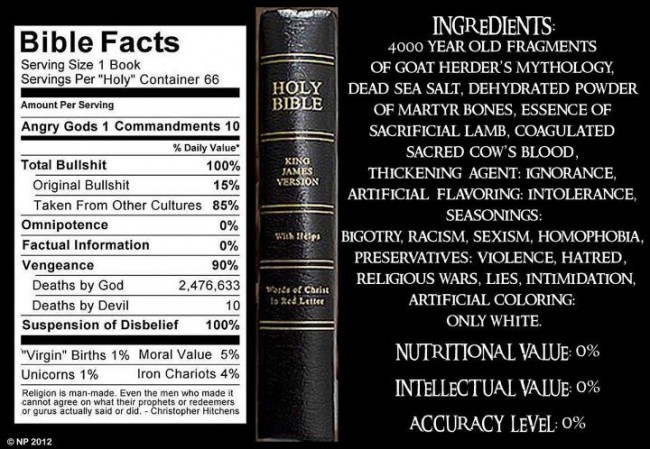
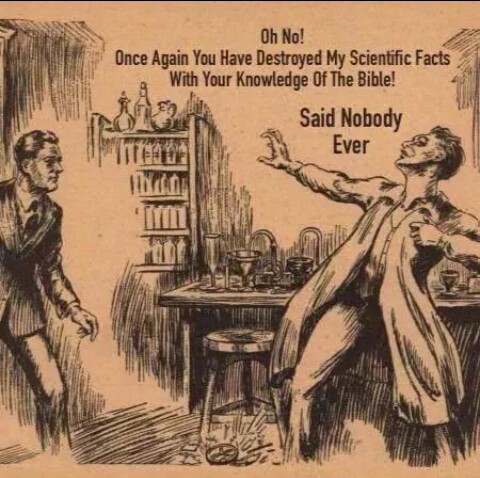
Despite having a lot of influence on history and literature, the bible is a completely worthless book. As a guide, it fails on virtually every single level. All of the value the bible does have is totally independent of any actual content. The bible fails as a:
|





|
|---|









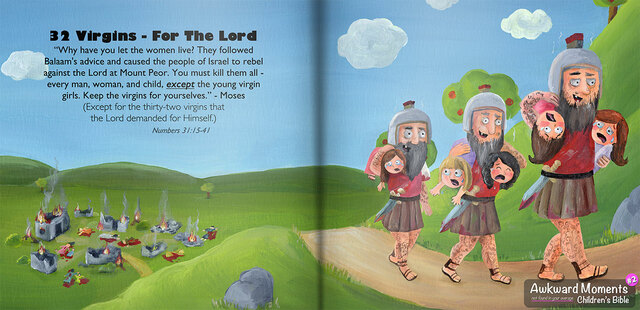











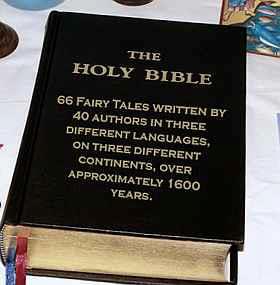
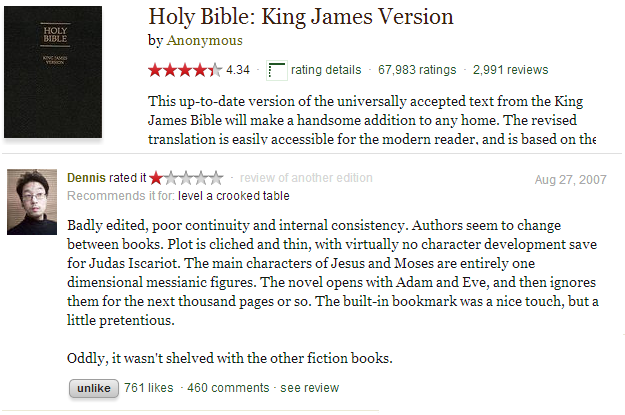
The Bible: Slavery Is Good. Gays Are Bad. Snakes Talk



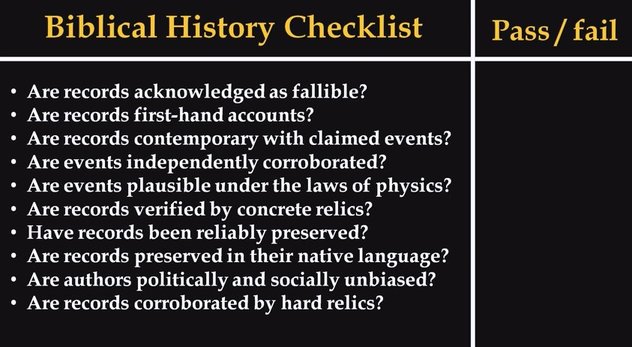
|
I cannot wrap my mind around those who claim the bible should be
the moral basis for our life.
The Bible is no bases for morality. Those who claim so pick only the nice verses to best suit their own morality. Throughout the Old Testament, multiple verses condone slavery, Leviticus 25:44-46, Exodus 21:2-4 (even within the context of this verse, slavery should never be condoned) Exodus 21:20 (treatment of said slaves). Richard Nisbet in 1773 wrote a response to an antislavery pamphlet, with his own entitled "Slavery Not Forbidden by Scriptures" where he used Old Testament verses to justify slavery. Now I say that to say that to say this, Christians of today I would hope, agree that slavery is wrong and abhorrent, and they would also say that Old Testament law no longer applies. Yet the Old Testament applies when it comes to current homophobic views and when it suited their needs. "Bible View of Slavery" by John H. Hopkins 1863, is another pamphlet in which this writer concludes that even though he himself would not condone slavery in normal circumstances, he must condone it because it is justified by the bible. This makes no logical sense; it is pure mental gymnastics. Even in the New Testament slavery is mentioned and condoned by Paul who could have made a statement against slavery, which being the time of the Roman Empire was common. But no, he calls for slaves to be subservient to their masters. Colossians 3:22 "Slaves, obey your earthly masters in everything; and do it, not only when their eye is on you and to curry their favor, but with sincerity of heart and reverence for the Lord." That Greek word for slave is doulos #1401 in the Strong's Concordance, the definition is "doúlos (a masculine noun of uncertain derivation) - properly, someone who belongs to another; a bond-slave, without any ownership rights of their own. Ironically, 1401 /doúlos ("bond-slave") is used with the highest dignity in the NT - namely, of believers who willingly live under Christ's authority as His devoted followers." And this is just about slavery, not the other multitude of times where killing women, babies, and people in general, is condoned. Rape is also condoned and abortion, under gods circumstances. Now what I am about to say is the 100% truth. People imprint their sense of morality upon the bible. Christians take the verses that sound nice and then twist the others that don't and say that "they are old law" or "that is out of context" to best suit their own needs and place themselves upon a morally high pedestal. I cannot for the life of me understand anyone who can critically think and conclude that the bible is a morally righteous and godly inspired text that should be the bases for all our lives and laws. It cannot serve as a moral guide when it itself is not moral. Have Christians ever read the bible? Also, any other atheist here that regularly just reads holy scriptures due to the sheer absurdity that you find in them? It intrigues me.
Why don't people believe in the bible? A talking snake convinces a naked woman to eat some fruit, resulting in an invisible man in the sky getting so upset about it that he makes her feel pain in childbirth, curses the ground to grow weeds and makes everybody worship him on pain of being tortured for all eternity in a fire. Later, a man hears voices in his head and tries to kill his own son. Then stops at the last minute only to be told by the voice in his head to mutilate his genitals and that of his children. Later still a man is talking to a Bush which tells him to go to Egypt and free the slaves and take them to Canaan - a land that, historically, was under Egyptian jurisdiction at the time anyway. They have a party then the invisible man in the sky slaughters a few thousand of them because they made a gold statue and didn't invite him. Later still a talking donkey begs a man to stop hitting him. Later a man who is his own father comes along, walks on water, cures people and even raises the dead, but nobody mentions it until 70 years after he dies and even then only by 4 people who want you to believe the story. Then a senile old man who is exiled on an island surrounded with psychoactive flora writes a very trippy book about a seven-headed monster. Seems legit to me. If I didn't know you were talking about the bible, I would have thought you were describing different psychological disorders.
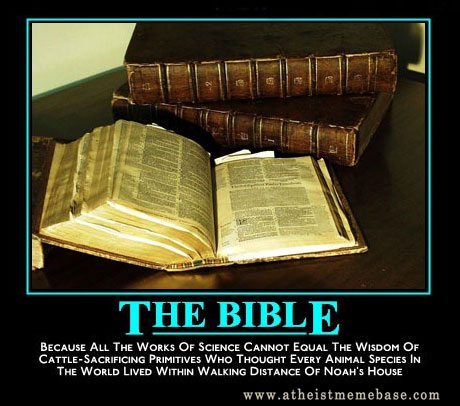
A few absurdities in the Bible: God intelligently designs foreskin on a man's penis, then directs its removal. (Ge. 17) God commands us to kill witches. God must know witches don't exist, right? (Ex. 22.18) God informs the Israelites to smear lamb's blood on their doorways so he doesn't get confused and accidently kill the favored Hebrew children. So apparently God can kill children indiscriminately, but sufferers from an odd form of supernatural dementia. (Ex. 12.3-13) Giants wandered the earth! (Nu. 13.33) Donkeys and trees talked. (Nu. 22.30), (Ju. 9.9) Unicorns and Dragons exist (Nu. 23.22, De. 33.17), (De. 32.33) God sends a serpent to bite people when they complain about starvation. Never complain to God. (Nu. 21.5-6) God goes out of his way to provide explicit rules for defecating in the woods, so he doesn't get his feet dirty. (De. 23.13) Samson kills 1000 people with the jawbone of an ass, apparently a serious weapon during the Iron Age. (Ju. 15.15) As punishment, God affects people with hemorrhoids in their "secret parts." (1 Sa. 5.6-12) Horse-drawn "chariots of fire" flew all the way to heaven. (2 Ki. 2.11) God change the position of the shadow on a sundial. (2 Ki. 20.10) The earth is claimed to be stationary. (Ps. 104.5) A guy named Jonah lived in the belly of a fish for several days. (Jo. 1.17)
The amount of Christians who haven’t actually read the Bible is shocking… How can you dedicate your life to a religion, but won’t take the time to actually read the foundational text associated with it. How can you spend hours and hours throughout your life praying and going to church and not sit down and read about what you’re actually praying about. Aren't you curious about the ideology you are pledging your life (and afterlife) to? I swear about half of the Christians I talk to have never actually read the Bible, and I’m skeptical of the half that said they have, after talking to them it’s pretty evident they haven’t actually read it cover to cover. I actually enjoyed reading the Bible, it’s super interesting from a historical and philosophical perspective. But I think it’s pretty embarrassing to call yourself a Christian, but the atheist you’re talking to has read the Bible and you haven’t.
It's only the very word of god written down as his only message to his following.
Whenever we read the obscene stories, the voluptuous debaucheries, the cruel and torturous executions, the unrelenting vindictiveness, with which more than half the Bible is filled, it would be more consistent that we called it the word of a demon, than the word of God. It is a history of wickedness that has served to corrupt and brutalize mankind; and, for my part, I sincerely detest it, as I detest everything that is cruel.” - Thomas Paine, The Age of Reason |
|
The Bible Before the Bible: When Scripture Had Competing Versions
For nearly two thousand years, a shorter Hebrew version of Jeremiah appeared to have vanished. The Greek translation survived, but it was considerably shorter than the Hebrew Book of Jeremiah preserved in Jewish tradition. Its chapters were arranged differently. Entire passages familiar to readers of the standard Hebrew Bible were absent. Because the Greek edition was a translation, many scholars naturally assumed that its translator had shortened the book, rearranged its material, or worked carelessly. Then fragments of Jeremiah emerged from caves near the Dead Sea. Some of those Hebrew fragments reflected a form of the book closer to the shorter Greek edition than to the longer Hebrew version that eventually became standard. The Greek translator had not necessarily removed large portions of Jeremiah. He may have been translating a different Hebrew edition of the book. That discovery opened a door into a forgotten world. It revealed that ancient Jewish communities did not always possess one identical version of every scriptural book. Two communities could both revere Jeremiah while reading different editions of Jeremiah. They could both preserve Deuteronomy while encountering different words in an important verse. They could both tell the story of David and Goliath while possessing noticeably different versions of the narrative. This does not mean the Bible was a chaotic collection in which every copy said something completely different. Many ancient manuscripts closely resemble the Hebrew tradition used today. Large portions of scripture were transmitted with impressive stability. But stability was not the whole story. Before one form of the Hebrew Bible became dominant, stability and diversity existed together. The Bible did not begin as a single book that was gradually corrupted into competing versions. It began as a collection of scrolls that developed, circulated, and survived through several overlapping textual traditions. Some differences arose through ordinary copying mistakes. Others came from clarification, harmonization, translation, or theological interpretation. In a few remarkable cases, entire books existed in more than one literary edition. Before the Bible became one standardized text, it was a conversation among scrolls. The Bible Was Not Originally a Book The physical form of a modern Bible creates an illusion. A Bible today appears as one complete object. It has a cover, a table of contents, numbered chapters, numbered verses, standardized spelling, and a publisher responsible for ensuring that every copy is identical. A reader can move from Genesis to Revelation without changing books, rooms, languages, or physical objects. Nothing like that existed when most biblical literature was written. Ancient scripture usually circulated as separate scrolls. A temple, synagogue, school, or private collection might possess Isaiah, Deuteronomy, Psalms, or Jeremiah without owning anything resembling a complete modern Bible. Even a wealthy community might possess only a limited collection of texts. Producing a scroll required expensive materials and skilled labor. Every word had to be copied by hand. A scribe worked from another manuscript that might already contain spelling differences, damaged sections, unclear handwriting, or earlier corrections. If a scroll wore out, a new copy had to be created. If part of it was torn or faded, the missing material might be reconstructed from another copy, a parallel passage, or inherited memory. Ancient Hebrew also lacked many of the reading aids found in modern editions. Early manuscripts did not contain the vowel systems later added by Jewish scholars. They did not use modern punctuation, chapter numbers, verse numbers, quotation marks, or standardized paragraph divisions. Even spelling could vary without changing the intended word. The Bible’s journey through history was therefore physical as well as theological. Sacred texts survived on animal skins, papyrus, ink, pottery fragments, and the memories of communities that believed the words were worth preserving. This does not reduce scripture to a series of mistakes. It explains the conditions under which scripture survived. Which Books and Which Versions? Two different questions must be separated. The first question is which books counted as scripture. The second is which version of a scriptural book a community possessed. The first question concerns the canon. Ancient Jewish communities did not all preserve exactly the same collection of sacred literature. Texts such as Enoch, Jubilees, Sirach, Tobit, and other works were copied, read, and valued by some communities without eventually entering the Jewish canon in its later form. Christian traditions would also disagree about which books belonged in the Old Testament. That is canonical diversity. Textual diversity is different. It existed when communities accepted the same book but possessed different forms of it. A shorter Jeremiah and a longer Jeremiah were still both Jeremiah. A Torah centered on Mount Gerizim and a Torah centered on the later Jewish tradition were still both regarded as the Torah by their respective communities. Different arrangements of the Psalms could still function as collections of sacred prayer. The popular discussion of biblical history often focuses on lost books. The more surprising reality is that some books were never lost, but their alternative forms nearly were. The Four Great Witnesses Four bodies of evidence are especially important for reconstructing the history of the Hebrew Bible. The first is the Masoretic Text. This is the Hebrew tradition underlying most modern Jewish Bibles and most Protestant translations of the Old Testament. It takes its name from the Masoretes, Jewish scholars who worked during the early medieval period to preserve the exact reading of the inherited Hebrew text. The Masoretes did not invent the Hebrew Bible. They received an ancient consonantal tradition and created an elaborate system to protect it. They added vowel signs, accents, chanting instructions, and marginal notes. They recorded unusual spellings and places where the traditional spoken reading differed from what appeared in writing. Their work represents one of the great achievements of textual preservation. The second witness is the Septuagint, the ancient Greek translation of Jewish scripture. The Torah began to be translated into Greek in Hellenistic Egypt several centuries before Jesus. Other books were translated at different times by different people. The Septuagint was therefore not one coordinated translation produced all at once. It was a growing collection of Greek Jewish scriptures. The Septuagint became especially important because many early Christians spoke Greek and used it as their Bible. New Testament authors frequently quoted Greek forms of scriptural passages. As Judaism and Christianity developed along different paths, Greek scripture remained central to Christianity while the Hebrew textual tradition that became the Masoretic Text became increasingly central to rabbinic Judaism. The third witness is the Samaritan Pentateuch. The Samaritans preserve their own form of the Torah and regard Mount Gerizim, rather than Jerusalem, as the sacred place chosen by God. Their Pentateuch contains thousands of differences from the Masoretic tradition, although most are minor. Some are specifically Samaritan. Others preserve a broader ancient style of harmonizing and expanding the Torah. The fourth witness is the collection known as the Dead Sea Scrolls. The Dead Sea Scrolls are not another single version of the Bible. They are a library of manuscripts representing several textual traditions. Some are close to the ancestors of the Masoretic Text. Some resemble the Hebrew sources behind the Septuagint. Some contain the harmonizing style found in the Samaritan Pentateuch. Others preserve independent readings that disappeared from every major surviving tradition. The scrolls did not reveal a new official Bible. They revealed the world before one textual tradition became official. The Caves That Reopened the Ancient World The discovery of the Dead Sea Scrolls began in the late 1940s near the ruins of Qumran, northwest of the Dead Sea. Over the following years, caves in the region yielded thousands of manuscript fragments representing hundreds of ancient works. The manuscripts dated from the final centuries before the Common Era through the first century of the Common Era. They included community rules, prayers, biblical interpretations, legal writings, apocalyptic visions, and copies of nearly every book later included in the Hebrew Bible. Their importance cannot be overstated. Before their discovery, scholars comparing the medieval Masoretic manuscripts with the Septuagint or Samaritan Pentateuch faced a difficult problem. The alternative traditions contained many readings absent from the standard Hebrew Bible, but the surviving copies of those traditions had their own complicated histories. A Greek difference might have been created by a translator. A Samaritan reading might have been introduced for sectarian reasons. Without older Hebrew witnesses, it was difficult to know. The Dead Sea Scrolls supplied those witnesses. They contained ancient Hebrew readings that agreed with forms previously known mainly through Greek translation. They also contained Torah manuscripts resembling the broader tradition behind the Samaritan Pentateuch without including all its specifically Samaritan claims. The evidence destroyed the idea that every ancient Hebrew manuscript belonged to one perfectly uniform textual line. It also destroyed the opposite idea that no stable tradition existed. Manuscripts close to the Masoretic form were already circulating alongside the alternatives. There was no single chaos. There was a structured plurality. Jeremiah and the Survival of Two Editions Jeremiah provides the clearest place to see the difference between an ordinary copying variation and a competing literary edition. The Greek Jeremiah is much shorter than the Masoretic Jeremiah. Its material is also arranged differently. The prophecies against foreign nations appear in another location, and many smaller expansions found in the Masoretic edition are absent. This is not the kind of difference created when a scribe misspells a word or accidentally skips one line. The two forms reflect different versions of the book. The discovery of Hebrew Jeremiah fragments related to the shorter form demonstrated that the Greek translator was not simply working with the longer Masoretic edition and cutting it apart. A shorter Hebrew Jeremiah was already circulating. The longer form appears to preserve additional names, explanations, repeated phrases, connective statements, and expansions. These additions may have accumulated as editors clarified Jeremiah’s historical world and connected its separate collections more firmly. This does not make the shorter edition authentic and the longer one false. The longer edition may preserve the final stage of an extended scribal process. The shorter edition may bring us closer to an earlier stage. Both formed part of Jeremiah’s history. Modern readers often imagine that an author completed a book, placed a final period at the end, and released a finished manuscript. Ancient literature did not always develop that way. Prophetic books could begin as speeches, poems, memories, reports, and smaller collections. Those materials were gathered, arranged, expanded, and transmitted by later scribes. Jeremiah may not have moved from one completed original directly into every later copy. It may have grown through successive editions. Ancient communities could agree that Jeremiah was sacred while disagreeing, without necessarily realizing it, about exactly how much Jeremiah contained. When Two Words Change the Heavens Jeremiah demonstrates that an entire book could exist in different editions. Deuteronomy demonstrates that only two words could preserve an older religious world. Deuteronomy 32 describes the Most High dividing the nations and assigning them their portions. The standard Masoretic Text says that the nations were divided according to the number of the “sons of Israel.” A reading preserved among the Dead Sea Scrolls refers instead to the “sons of God.” The Septuagint contains a related reference to divine beings or angels. The difference is small on the page but enormous in meaning. The phrase “sons of Israel” connects the number of nations with the traditional descendants of Jacob. The phrase “sons of God” reflects an older divine council worldview. In that reading, the Most High apportions the nations among heavenly beings, while the next verse identifies Israel as YHWH’s own portion. The passage then fits a wider ancient picture in which the heavens contain a council of divine beings under the authority of the supreme God. Similar imagery survives in texts such as Psalm 82 and Job, where heavenly beings appear before God. The later “sons of Israel” reading may reflect discomfort with that older worldview. A scribe or textual community may have replaced the divine beings with a phrase that sounded less mythological and more compatible with developing Jewish monotheism. The motive cannot be proved with absolute certainty. What can be shown is that an ancient Hebrew manuscript and the Greek tradition preserve a reading different from the later standard Hebrew form. A change of two words can preserve or conceal an entire cosmology. The Most Famous Stone in the Bible If Jeremiah feels remote and Deuteronomy sounds technical, the next example concerns one of the most familiar stories in Western culture. David and Goliath did not always circulate in the exact narrative form readers know today. The Greek version of 1 Samuel 17 and 18 is substantially shorter than the Masoretic Hebrew version. It lacks many sections found in modern Bibles based on the traditional Hebrew text. The shorter story moves with remarkable speed. Goliath challenges Israel. David arrives. David hears the challenge, confronts the giant, kills him, and transforms the battle. The longer Masoretic edition includes additional conversations, movements, promises, descriptions, and conflicts involving David’s brothers and King Saul. These additions make the story richer, but they also create problems. In the preceding chapter, David has already been introduced to Saul as a musician and armor bearer. Saul values him and requests that David remain in his service. Yet after David defeats Goliath, Saul appears not to know who David is and asks about his family. Commentators have proposed many ways of reconciling these scenes. Saul may have known David but not his father. Saul may have been asking about David’s lineage because he had promised a reward. David’s earlier service may have been temporary. The shorter Greek version avoids much of the difficulty because several of the connecting passages are absent. This does not automatically prove that the Greek version is original. The translator may have shortened the narrative. A Hebrew source could have lost material. The Masoretic version could preserve expansions from another David tradition. The textual history of Samuel is especially difficult because its Hebrew transmission appears to have suffered damage in several places. What can be said confidently is that ancient readers encountered a shorter form of the story and a longer form of the story. Both versions contain David, Goliath, the sling, the stone, and the victory. What differs is how much narrative surrounded the stone. This is important because it brings textual history out of obscure footnotes. Variation did not affect only legal measurements and forgotten genealogies. It touched stories that became central to art, politics, literature, and popular imagination. The Samaritan Torah and the Mountain God Chose The Samaritan Pentateuch shows how the identity of a community could shape the form of its scripture. Samaritans and Jews share ancient Israelite roots, but their histories separated. Jewish worship became centered on Jerusalem. Samaritan worship became centered on Mount Gerizim near Shechem. The Samaritan Torah does more than interpret Mount Gerizim as sacred. It places the mountain within the wording of the commandments. Its version of the Ten Commandments includes a command directing Israel to build an altar on Mount Gerizim. The passage gathers language found elsewhere in Deuteronomy and brings it into the revelation at Sinai. The result gives Mount Gerizim the authority of the covenant itself. This is clearly connected with Samaritan sacred geography. But not every difference in the Samaritan Pentateuch was invented by Samaritans. Some Qumran Torah manuscripts contain the same general style of expansion and harmonization found in the Samaritan text while lacking its specifically Samaritan claims. These manuscripts show that the Samaritans inherited an ancient form of the Torah that already tended to combine parallel passages and resolve inconsistencies. For example, Exodus and Deuteronomy provide different reasons for keeping the Sabbath. Exodus grounds the command in God’s rest after creation. Deuteronomy connects it to Israel’s liberation from slavery in Egypt. A harmonizing manuscript can preserve both reasons together rather than forcing the reader to choose between them. From a modern editorial perspective, this is an alteration. From the perspective of an ancient scribe, it could have looked like preservation. Nothing was being denied. Both sacred explanations were being gathered into one fuller command. The Samaritan Pentateuch therefore contains several layers of history. It preserves ordinary copying variations, ancient harmonizations, inherited expansions, and later readings supporting Mount Gerizim. The question is not whether Jews or Samaritans changed the Torah while the other community preserved it untouched. Both traditions participated in a much older history of transmission, interpretation, and selection. Before Psalms Ended at 150 The Psalms also circulated with less fixed boundaries than modern readers might expect. The Masoretic Psalter contains 150 psalms. The Septuagint includes an additional Psalm 151 associated with David’s victory over Goliath. The Great Psalms Scroll from Qumran preserves a collection arranged differently from the standard Psalter and includes compositions absent from the Masoretic form. This does not necessarily mean every poem in the Qumran scroll was universally regarded as canonical scripture. Ancient manuscripts do not come with modern labels explaining the exact status of each composition. A scroll could gather sacred, liturgical, instructional, and devotional material without drawing the boundaries later readers expect. The evidence still shows that the arrangement and outer edges of the Psalms remained open in at least some communities. Order matters. A collection is more than a container. The placement of a poem can change its function. An opening psalm can teach readers how to approach everything that follows. A final psalm can turn the entire collection toward praise, memory, kingship, wisdom, or hope. Before the Psalms became one numbered book permanently ending at 150, they were collections of prayer and song whose contents and arrangement could still move. How Sacred Texts Changed Not every variation has the same explanation. Some differences resulted from accidental copying errors. A scribe could look away from the manuscript and return to the wrong occurrence of a repeated word. Everything between the two occurrences might disappear. A word could be copied twice. Similar letters could be confused. A damaged scroll could leave the scribe with incomplete material. These are ordinary copying variations. Other differences came from interpretation. A scribe could replace an unclear pronoun with a name, update an unfamiliar expression, explain a location, or make two parallel accounts agree more closely. These are clarifying and harmonizing variations. A third category involves editorial development. A collection could receive new speeches, descriptions, transitions, or conclusions. Separate traditions could be combined. An earlier edition might remain in circulation while a longer edition developed elsewhere. Jeremiah belongs largely in this category. The David and Goliath narrative may as well. Finally, theological and communal concerns could influence transmission. An older reference to divine beings might be replaced with language more acceptable to later theology. A sacred mountain might be placed more directly inside the commandments of Moses. These changes should not all be described as corruption. That word assumes that every scribe possessed a modern understanding of authorship, textual ownership, and exact reproduction. Ancient scribes could regard clarification, expansion, and harmonization as faithful acts. They were not necessarily trying to create a different Bible. They were trying to preserve what they understood the Bible to mean. How One Hebrew Tradition Became Dominant The period of textual plurality gradually narrowed. The Hebrew tradition that would become the Masoretic Text already existed during the Second Temple period. Qumran manuscripts close to it prove that its ancestry is ancient. It was not created in the Middle Ages. Over time, this textual family became increasingly dominant in Jewish communities. The destruction of the Jerusalem Temple in 70 CE changed the Jewish religious world. Some sects disappeared. Others lost influence. Rabbinic communities became increasingly important in preserving Jewish law, worship, interpretation, and identity. A shared scriptural text offered enormous practical advantages. Public reading, legal debate, memorization, education, and commentary all became easier when communities worked from a common wording. This standardization did not happen through one known council that ordered every competing scroll destroyed. It appears to have been gradual. One ancient textual family gained authority, was copied more consistently, and eventually displaced most alternatives within rabbinic Judaism. Centuries later, the Masoretes inherited that tradition and protected it with extraordinary precision. Their work should not be minimized simply because other ancient forms once existed. The Masoretes preserved the Hebrew text so carefully that later manuscripts could be checked against detailed notes concerning spelling, pronunciation, accents, unusual forms, and expected word counts. They did not stand at the beginning of the Bible’s history. They stood near the end of its long movement toward textual stability. The Footnotes That Remember The ancient plurality of scripture has not completely disappeared. It survives in the footnotes of modern Bibles. A reader may encounter a note saying that the Dead Sea Scrolls and Septuagint contain additional words. Another note may say that the Masoretic Text reads differently. Some translations quietly adopt an alternative ancient reading while recording the traditional Hebrew wording below. These notes are not evidence that translators are hiding a crisis. They are evidence that responsible translation requires comparison. Modern textual critics examine the Masoretic Text, Dead Sea Scrolls, Septuagint, Samaritan Pentateuch, Syriac translations, Latin traditions, biblical quotations, and parallel passages. They study which manuscripts are oldest, how a translator normally worked, which mistakes scribes commonly made, and which reading best explains the existence of the alternatives. The oldest manuscript is not automatically correct. The longest reading is not automatically original. The strangest reading is not automatically ancient. Every case must be examined on its own evidence. Sometimes the Masoretic Text clearly preserves the strongest reading. Sometimes the Dead Sea Scrolls or Septuagint preserve wording that appears older. Sometimes the history cannot be reconstructed with certainty. The small print at the bottom of the page is where the modern Bible quietly remembers the world before standardization. What This History Does Not Mean This history does not mean that the Bible was created at the Council of Nicaea. The major textual traditions discussed here began developing centuries before Constantine and the fourth century Christian councils. It does not mean every manuscript was radically different. Most variations are small, and many ancient copies show significant continuity with the traditions used today. It does not mean the Masoretic Text is unreliable. The Dead Sea Scrolls confirm that its textual ancestors are ancient. What the scrolls challenge is not the antiquity of the Masoretic tradition, but the claim that it was always the only Hebrew tradition. It also does not mean every version is equally valuable in every passage. Textual criticism exists precisely because manuscripts must be compared and evaluated. Most importantly, variation does not make the history unknowable. Variation is part of what allows the history to be reconstructed. Differences reveal how scribes copied, how communities interpreted, how books developed, and how one tradition eventually became dominant. The existence of variation is not the destruction of the evidence. It is the evidence. The Bible Before the Bible For nearly two thousand years, the shorter Hebrew Jeremiah disappeared. Its Greek descendant survived, but the Hebrew scroll behind it could no longer be seen. Scholars could only compare the Greek version with the longer Masoretic book and wonder what had happened. Then fragments emerged from the Judean desert. Those fragments did not expose a false Bible hiding beneath the real one. They exposed the older world from which every surviving Bible descended. In that world, Jeremiah circulated in more than one edition. Deuteronomy preserved competing visions of the heavenly order. David’s victory over Goliath appeared in shorter and longer forms. Samaritan scripture placed Mount Gerizim inside the revelation of Sinai. Collections of Psalms could contain different arrangements and additional prayers. Eventually, one Hebrew textual family became dominant in rabbinic Judaism. The Masoretes preserved it with remarkable care. Greek speaking Christians continued using the Septuagint. Samaritans protected their Torah. Other Hebrew forms disappeared, survived indirectly through translations, or waited in caves to be discovered again. The Bible was not preserved because human beings never touched it. It was preserved because generation after generation refused to stop touching it. They copied it when the parchment wore thin. They translated it when their children no longer spoke the original language. They carried it through exile, conquest, persecution, migration, and the collapse of entire civilizations. They clarified it, debated it, sometimes expanded it, sometimes misunderstood it, and eventually learned to reproduce one form of it with astonishing precision. The Bible is not a book without a human history. It is a book that survived because of one. Before it was bound beneath one cover, it was a library. Before the library became standardized, it was a conversation among scrolls. The Dead Sea Scrolls allowed that conversation to speak again. I write essays and books like this because I believe people deserve access to biblical history without fear, manipulation, or demands that they ignore the evidence. I am also a special needs teacher working toward a much larger dream of creating a school and meaningful employment opportunities for people with special needs. Supporting my books helps me continue this work and move that dream closer to reality. You can read and support my work here: https://a.co/d/04V7z9S6
|




Send comments to:
 hjw2001@gmail.com
|
